Balancing Security and Customer Experience in ID Verification
The best security system in the world is worthless if your customers refuse to use it, and the smoothest customer experience means nothing if it lets an underage patron slip through the door. Most operators treat these two goals as a tug-of-war, where every step toward tighter compliance costs you a little goodwill at the entrance. That framing is wrong. Done well, verification is one of the fastest, most reassuring moments a guest has with your business, not the price they pay to get inside.
Security and speed are not opposites
The idea that tighter security means slower service comes from the days of squinting at a laminated card under a flashlight and doing birthday math on your fingers. That was slow. Good technology is the opposite: a clean two-second scan is faster than any manual process, it eliminates confusion about what a valid ID looks like, and it applies the same rule to every person in line. Consistency is what actually keeps a queue moving.
The other myth is that customers hate being checked. In reality, most people appreciate walking into a room where everyone was verified the same way they were. A professional, quick check reads as competence, not suspicion. What people resent is not the check itself but a check that feels arbitrary, sloppy, or rude. Fix that, and the resistance mostly disappears.
What customers actually want
Strip away the details and a guest at your door wants five things. They want to be served quickly. They want to be treated with respect. They want the rules applied fairly, so the person ahead of them does not get waved through while they get grilled. They want their personal information handled carefully. And, whether they say it out loud or not, they want to feel safe once they are inside.
The frustrations are the mirror image of that list. Inconsistent enforcement, slow manual entry, an unprofessional door person, unclear requirements, and technical failures are the things that turn a routine entrance into a bad review. What delights people is equally simple: a swift scan, a friendly greeting, clear communication, modern tools that obviously work, and the small thrill of being recognized as a regular.
Designing the moment
The verification experience starts before anyone arrives. Tell people what they need to bring. Publish it on your site, mention it in reservation confirmations, and answer the obvious questions before they become an argument at the rope. A guest who knows a valid ID is required is a guest who already has it out when they reach the front.
At arrival, the door should look organized and staffed, with clear signage and a line that makes sense even when it is busy. The verification itself is where the work pays off: a warm greeting, a professional request, a quick scan, an instant accept, and a smooth handoff into the room. When the whole thing takes a couple of seconds and ends with a genuine welcome, the guest barely registers that they were screened at all. That is the goal.
Let the technology carry the weight
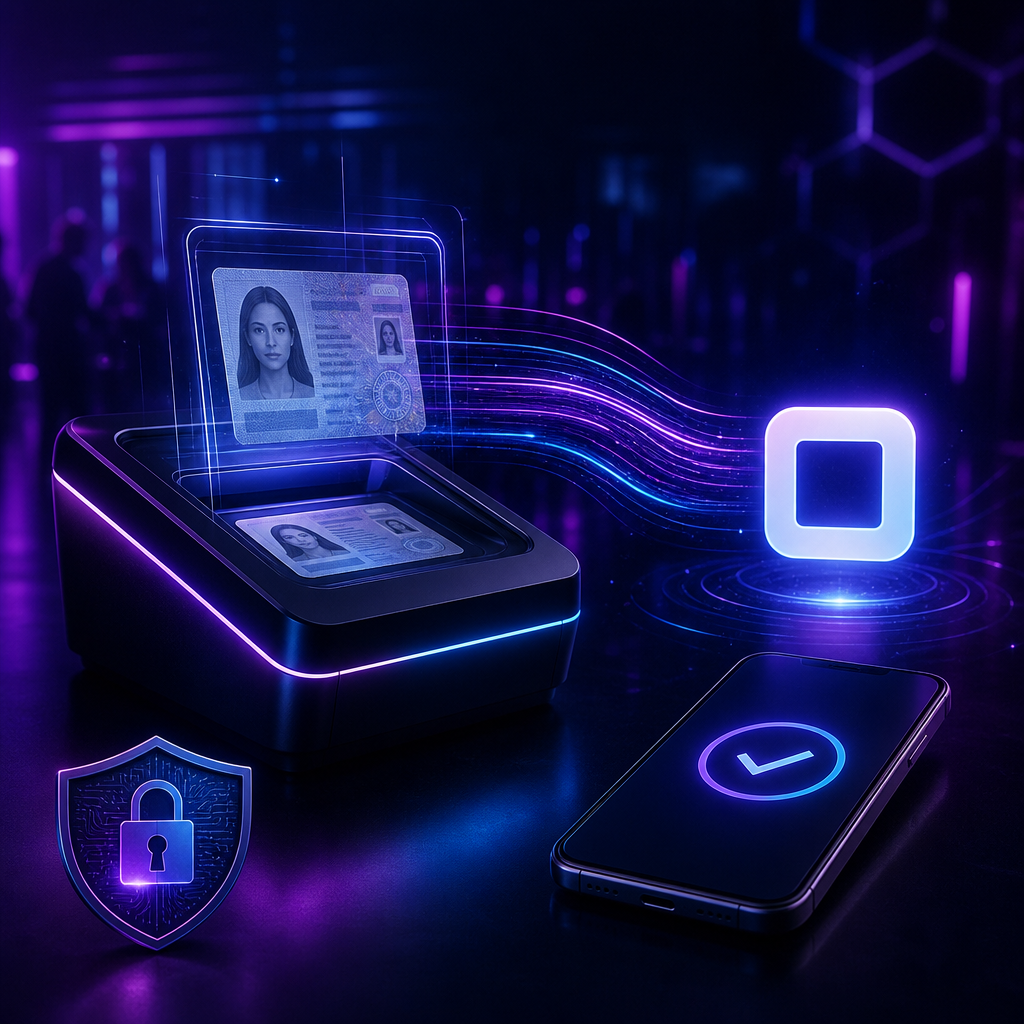
This is where ID Verify does its job. A two-second scan with instant validation removes the two biggest sources of delay and error: manual data entry and mental arithmetic. The software reads the document, confirms it, and logs the check automatically, so your staff are never calculating dates or transcribing numbers by hand at one in the morning. For the customer, that means minimal waiting and a consistent experience every single visit. For you, it means a clean, timestamped record without anyone thinking about it.
The same tooling smooths out the edges of a busy night. One-touch scanning with a clear accept or decline result means your door staff always know exactly where they stand, and features like VIP fast-track and loyalty recognition turn a compliance step into a service moment. The check that keeps you legal can also be the thing that makes your best customers feel known.
Train the words, not just the process
Technology handles the scan. Your staff handle the human being attached to the ID, and the difference between a good interaction and a bad one is often a single sentence. The mindset to instill is that security enables service rather than fighting it, and that every interaction, even a two-second one, shapes how someone feels about the whole place.
Language matters more than most owners realize. "I need to see your ID" lands very differently from "Good evening, may I verify your ID?" When a scan fails, "This looks fake" is an accusation that invites a fight, while "I'm having trouble scanning this, let me grab my manager" is a neutral request for help. And when someone cannot come in, "You can't come in" is a wall, whereas "I'm unable to verify this ID, here are your options" gives them a way forward. Same outcome, completely different night.
The classic objections are predictable enough that you can rehearse them. When a regular protests that they come here all the time, thank them for their loyalty and explain that the same check keeps the room safe for everyone. When someone forgot their ID, acknowledge that it is genuinely frustrating, point to the law, and offer a nearby alternative if you have one. When someone calls the whole thing ridiculous, stay calm and lean on fairness: the policy applies to every guest, without exception. Consistency is not just good compliance, it is your best de-escalation tool, because there is no argument to be had about a rule that has no exceptions.
When something goes wrong
Systems fail, lines get long, and people make mistakes. What separates a forgettable hiccup from a lost customer is how you recover. The pattern is always the same: acknowledge the problem immediately, apologize like you mean it, fix it quickly, make it right in a way that fits the situation, and follow up personally when it warrants it. A scanner that goes down during a rush is recoverable if you have a backup plan and staff who stay calm; it is a disaster only if everyone freezes and the line turns into a mob.
Measure what you are trying to improve
You cannot manage the door experience if you are not watching it. On the customer side, track wait times, satisfaction, complaint rates, and how often people come back. On the operational side, watch processing speed, error and compliance rates, and system uptime. Pair the numbers with real feedback from exit surveys, online reviews, and the occasional mystery shopper, then actually do something with it: review the trends, coach the staff, and adjust the process. Feedback you collect and ignore is worse than no feedback at all.
The payoff
The choice between security and service is a false one. When verification is fast, consistent, and handled by people who know what to say, tight compliance and a great guest experience stop competing and start reinforcing each other. Customers appreciate a business that takes their safety seriously while respecting their time and dignity, and that appreciation shows up in reviews, in return visits, and in a door team that is not constantly bracing for a fight.
ID Verify gives you the foundation: the speed, accuracy, and automatic recordkeeping that manual checks simply cannot match. The rest is yours to build with good training, sensible process, and genuine attention to the person on the other side of the scan. Assess where you are today, fix the friction you find, and treat every verification as a chance to prove that safety and service were never opposing forces to begin with.