International ID Verification: A Global Guide
Sooner or later, someone hands you a document you have never seen before. Maybe it is a French national ID card, maybe a Japanese residence card, maybe a passport printed in a script you cannot read. Your domestic license reference chart is useless, the birthday math is now in day-month-year order, and there is a line of people behind them. This guide is about staying calm and getting it right when the document in your hand comes from somewhere else.
The documents you will actually see
Passports are the common thread. More than 190 countries issue them, they follow a shared international format, and they are the one document almost anyone crossing a border will have. Beyond passports, you will run into national ID cards, foreign driver's licenses, residence permits, and visa documents, each with its own quirks.
Then there are the regional systems worth knowing by name. The EU and EEA issue standardized ID cards that look broadly similar across member states. The United States has REAL ID and enhanced licenses. India has Aadhaar, Mexico has the CURP-linked cards, Malaysia has MyKad. You do not need to memorize all of them, but recognizing what a document is supposed to be is half the battle.
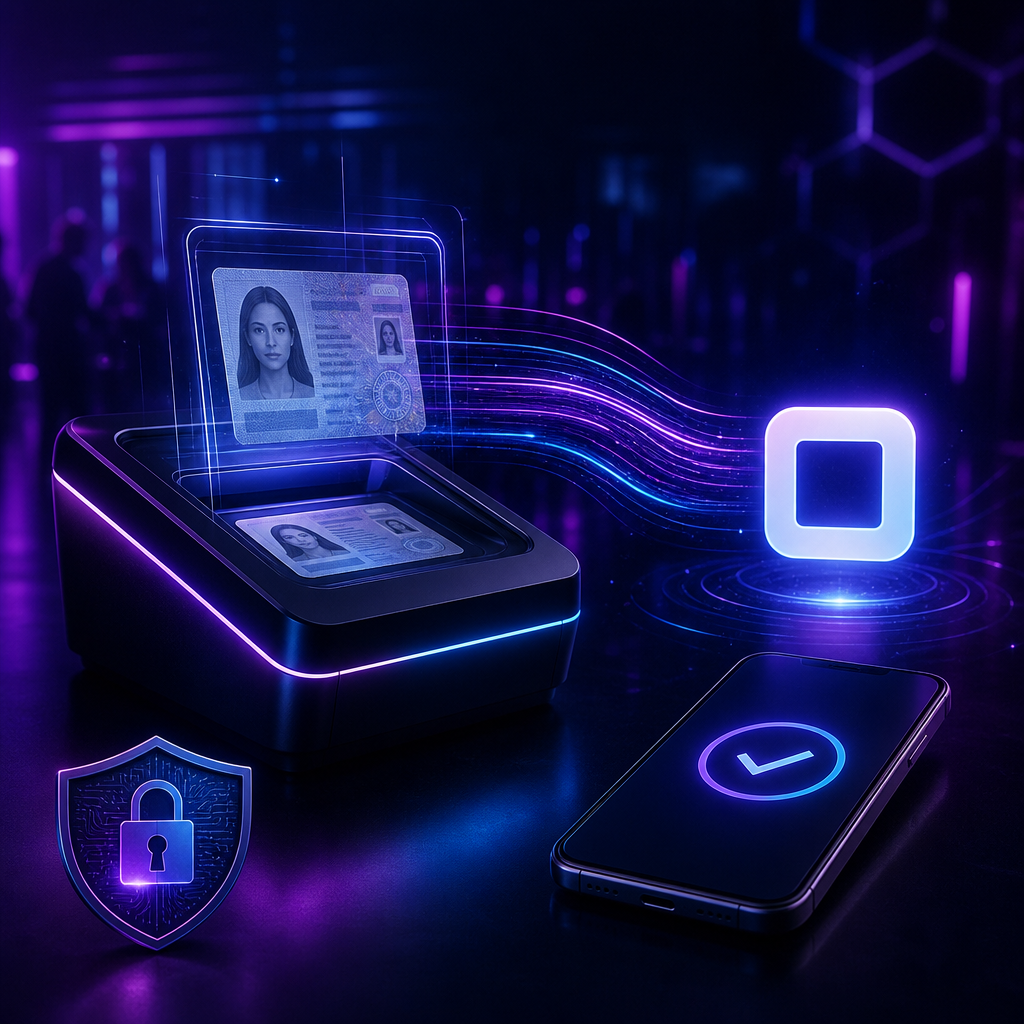
The good news is that legitimate documents share a family of security features. Machine-readable zones, holograms, watermarks, and embedded security threads show up almost everywhere. Modern passports and many national IDs go further, carrying biometric chips, RFID or NFC data, digital signatures, and cryptographic keys that let a machine confirm the document has not been tampered with. The features vary, but the underlying idea does not: a real document is hard to fake because it is layered.
Reading a passport the right way
Passports are the easiest foreign document to verify precisely because they are standardized. ICAO Document 9303 governs how they are built, from the biometric chip to the machine-readable format, which means a scanner that understands the standard can read a passport from almost any country.
The workhorse is the machine-readable zone, those two or three lines of monospaced characters at the bottom of the photo page. The format is fixed: country codes, document number, date of birth, expiration, and a set of check digits that catch transcription errors. If the check digits do not add up, something is wrong, and you know it in a fraction of a second without needing to read the language.
Physical inspection still matters. Tilt the document under light and look for holographic elements, hold it to UV and watch the fluorescent features appear, check the watermark and the security thread, and make sure no page has been swapped or the photo replaced. Where the technology allows, go a step further and let a reader authenticate the chip, validate the digital signature, and match the biometric data against the printed photo. Physical and digital checks together are far stronger than either one alone.
What changes region to region
Europe is comparatively friendly. EU and EEA ID cards follow a common format with shared security features and biometric chips, though the text is multilingual and the specifics shift across the 27 member states. Formats get updated on their own cycles, and Brexit added its own wrinkle to what counts as a valid UK document, so keep your references current.
Asia-Pacific is where the diversity really shows. You will see Chinese, Japanese, and Korean character sets, often alongside a Latin transliteration, on documents ranging from Chinese ID cards to Japanese residence cards, Korean registration cards, Indian Aadhaar, and Australian licenses. Security levels and technology adoption vary widely, so a document that looks sparse is not automatically suspect.
The Americas bring their own patchwork. North America alone spans US state-by-state variation, Canadian provinces, Mexican states, and the ongoing REAL ID transition. Across Latin America you will encounter national cédula cards, migration documents, and a real spread in security sophistication from one country to the next.
Where verification gets hard
The first wall most people hit is language. Non-Latin scripts, unfamiliar date formats, address structures that do not map to anything you know, and names that transliterate half a dozen ways all slow you down and invite mistakes. The fix is partly tooling, with multi-language support and character recognition doing the heavy lifting, and partly training, so your staff knows that a European date reads day first and a Chinese name often puts the family name first.
The second wall is authentication itself. When you have never seen a document type, you do not know which security features to expect or where to look, and you have few reference points for spotting a fake. This is exactly where unfamiliarity becomes risk. Leaning on a good reference database, expert consultation when the stakes are high, and technology built for the job turns an intimidating document into a routine one.
Letting technology carry the load
This is the problem ID Verify was built to solve. The international platform covers more than 190 countries and over 3,500 document types, reading them in real time, calculating age correctly regardless of local date format, translating fields automatically, and flagging the signs of fraud a tired human eye tends to miss.
Underneath, pattern recognition and anomaly detection compare a document against what a genuine one of its type should look like, examining fonts, templates, and layout for the small inconsistencies that give a counterfeit away. For businesses with heavier compliance duties, the platform can screen against INTERPOL and government databases, sanctions lists, and politically exposed person records, turning a manual research project into a single check.
Compliance and the record you keep
If you are in a regulated industry, verification is only half the obligation. Know Your Customer and anti-money-laundering rules, FATF recommendations, UN sanctions, and GDPR all shape how you verify and what you do with the result. Financial services, travel, healthcare, education, and employment each layer their own requirements on top.
Keeping records is not optional. Retain the verification result, any translation or decision rationale, and a clean audit trail. Retention periods vary by jurisdiction but commonly land in the five-to-seven-year range, and the records need to be stored securely and actually retrievable when a regulator or auditor asks. A verification you cannot prove you performed is, for compliance purposes, a verification that did not happen.
The practical playbook
For a foreign document, a reliable protocol looks like this:
- Examine the physical document and confirm it is the type it claims to be.
- Check the tactile and visual security features under normal and UV light.
- Scan it, reading the machine-readable zone and any chip.
- Validate against the relevant databases or watchlists if your industry requires it.
- Make and record the decision, including your reasoning if you declined.
When something feels off, or the transaction carries real risk, escalate. A second set of eyes, a supervisor review, or a request for a supporting document costs a minute and can save you from a bad call.
A few things are worth doing regardless of the tools you use. Train staff to recognize document types and read security features rather than trusting a photo and a birthday. Build systems that handle names the way the world actually writes them, with room for multiple surnames, patronymics, and Unicode characters, so a legitimate customer is not turned away because your form only has one name field. And treat people with patience: someone handing over a foreign passport is often navigating a language barrier of their own, and courtesy costs nothing.
The bottom line
International verification is complex, but it is manageable with the right tools, decent training, and a consistent procedure. As people move across borders more freely and more often, being able to confidently verify a document from anywhere stops being a nice-to-have and becomes both a compliance necessity and a genuine advantage.
The balance you are always striking is security against service, thoroughness against speed, and technology against human judgment. No single approach covers every situation, which is why a solid platform paired with a well-trained team beats either one on its own. If you want that foundation, ID Verify's international coverage of 190-plus countries and 3,500-plus document types is a good place to start, and we are happy to walk you through it whenever the next unfamiliar document lands on your counter.