The Future of ID Verification Technology
Verifying an ID used to mean holding a card up to the light and squinting. That world is disappearing fast. Fraudsters have gotten better tools, regulators have gotten more demanding, and the technology sitting between the two has had to grow up in a hurry. None of this means you need to rip out your setup tomorrow, but it does help to know which way the wind is blowing before you make your next equipment decision. Here is where things stand and where they are headed.
Where we are right now
The baseline has already shifted under most operators' feet. Digital IDs have moved from novelty to something you will actually see at the door. Verification is mobile-first because the person checking is usually holding a phone, not standing at a fixed terminal. Customers expect the answer to come back in real time, not after a pause that stalls the line. Biometrics are creeping in around the edges, and the systems doing all this work now live in the cloud rather than on a dusty box in the back office. If that describes your operation, you are current. If it does not, this is the gap worth closing first.
AI is quietly doing the hard part
The most useful change is happening where you cannot see it. Machine learning models catch fake IDs that a tired human eye misses, because they are comparing thousands of tiny structural details at once rather than eyeballing the hologram. They can flag suspicious presentation patterns, like the same document showing up at three venues in one night. And because these systems learn from every scan across the network, a new counterfeit technique spotted in one state can be recognized everywhere else within days instead of months. You do not have to retrain your staff every time the forgers get clever. The software adapts on its own.
Biometrics and the death of the shared ID
The oldest trick in the book is borrowing an older sibling's license. Biometrics are what finally close that door. Facial recognition matches the living person to the photo on the document, and liveness detection confirms you are looking at an actual human rather than a photo of a photo. Fingerprint scanning is already routine in a few high-security settings, and voice or iris checks exist for venues that genuinely need that level of certainty. Most bars will never need an iris scanner. But a face-to-photo match is fast, unobtrusive, and increasingly practical, and it neutralizes the single most common form of underage entry.
The digital driver's license arrives
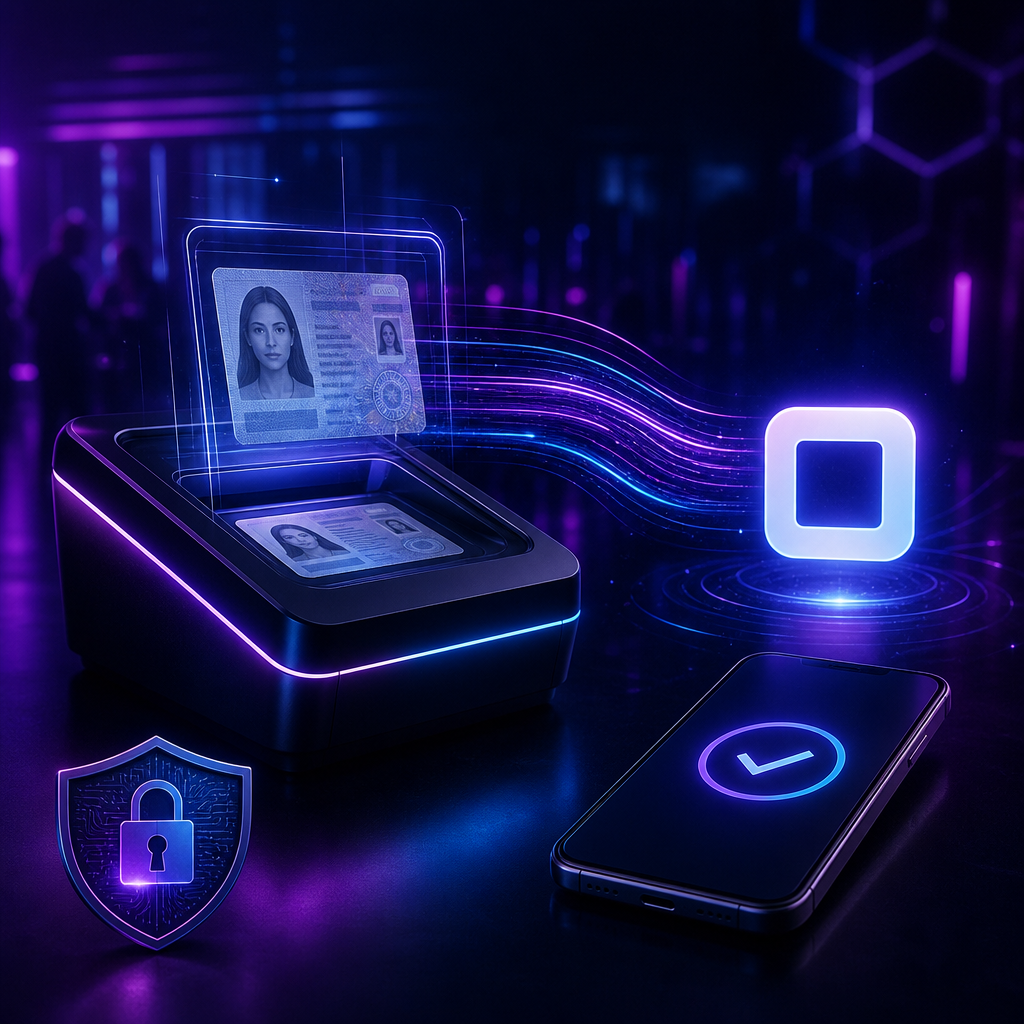
The biggest shift on the horizon is the ID itself going digital. A mobile driver's license lives in the phone's secure wallet, encrypted and nearly impossible to forge in the way a laminated card can be. It also lets the holder share only what is needed, which matters more than it sounds.
Arizona, Colorado, and Maryland led the way, and both Apple Wallet and Google Wallet have been steadily expanding support. The TSA has begun accepting mobile IDs at airport checkpoints, and private businesses are watching closely, getting ready for the day a meaningful share of customers reach for a phone instead of a wallet.
For you, the practical upshot is better than it might seem. A digital ID validates instantly through a secure protocol, so there is no physical card to handle, inspect, or accidentally drop in a puddle. Age gets calculated automatically, a revoked or suspended license can be flagged in real time, and the customer reveals their birthdate and legal age without handing over their home address and everything else printed on a physical card.
Physical cards are not standing still
Even as digital IDs rise, the plastic in people's wallets keeps getting harder to fake. Newer licenses use polycarbonate construction, laser engraving that cannot be altered without destroying the card, and layered security features both visible and hidden under UV. Some now carry embedded chips. The takeaway is that the counterfeiter's job is getting harder from both directions at once, and verification tools that read these newer features will keep separating the real from the fake long before your staff would notice a difference.
Privacy becomes a feature, not an afterthought
Collecting identity data used to mean quietly becoming a target. The emerging approach flips that. Zero-knowledge proofs let a system confirm that someone is over twenty-one without ever exposing the actual birthdate, and techniques like encrypted-in-place processing mean sensitive data never has to sit around in readable form. Alongside the technology, the rules are tightening. GDPR-style privacy laws are spreading across states, biometric data is picking up its own regulations, and the right to have your data deleted is becoming a baseline expectation rather than a courtesy. The businesses that get ahead of this treat privacy as something they offer customers, not a compliance chore they resent.
What it looks like in your industry
The details land differently depending on what you run. Hospitality and entertainment venues are moving toward pre-verification, so a guest clears the age check before they arrive and walks into a contactless entry instead of a bottleneck at the rope. Retail and e-commerce face a harder problem, because age-restricted delivery, curbside pickup, and self-checkout all need a way to confirm age without a person standing there, and cross-channel identity is the thread that ties those together.
Cannabis operators live with the most moving parts. Seed-to-sale tracking already ties every transaction to a verified purchase, medical recommendations need their own verification layer, and the whole industry is quietly preparing for a future where interstate commerce, federal changes, and normal banking access are all on the table. Verification that plugs into that reality rather than fighting it is worth far more than a generic scanner.
Preparing without overreacting
You do not need a five-year moonshot plan. Over the next year, the sensible moves are practical ones: get onto a cloud-based system if you have not, train your staff to recognize and accept digital IDs, connect your verification to the tools you already use, and tighten how you handle the data you collect. Over the next couple of years, it is worth seriously evaluating biometric options and leaning toward AI-powered systems as they prove themselves. Further out, digital IDs and privacy-preserving verification will likely become the default rather than the exception, and the operators who started early will find the transition boring instead of frightening.
The honest challenges are real too. Legacy systems resist integration, new tools cost money, and staff need time to adjust. There are social questions worth taking seriously, from customers who are wary of biometrics to the plain fact that not everyone carries a smartphone. Good technology has to leave room for the person who still hands you a physical card, and it will for a long while yet.
Where ID Verify fits
We build with all of this in mind rather than bolting it on later. The platform ships regular updates, integrates with the point-of-sale and compliance tools you already rely on, and is designed so the people actually using it at the door find it obvious rather than annoying. Usability is what drives adoption, and adoption is what makes any of this pay off.
The tools of identity verification will keep changing, but the job underneath them does not. You still need to confirm age reliably, stay compliant, and keep the line moving without treating honest customers like suspects. If you want a verification setup that grows into the future instead of aging out of it, ID Verify is built to come along for the ride. Start where you are, and let the technology catch up to the rest of your operation one sensible step at a time.