How to Spot Fake IDs
Fake IDs keep getting better. The days of a smudgy laminated card a kid printed in a dorm room are mostly behind us, and what crosses the counter now can be genuinely convincing. But convincing is not the same as flawless. Almost every fake still trips over a detail somewhere, and once you know where to look, you start catching things your gut already suspected. This is a walk through the tells that matter, the tests worth running, and what to actually do when a card doesn't add up.
Start with your hands, not your eyes
Before you study the photo or hunt for a hologram, feel the card. A real license has a particular thickness and a particular give. Fakes tend to run too thick or too flimsy, and the laminate often gives itself away first, feeling slightly off or bubbling at the edges where it was applied by hand instead of pressed at a factory. The bend test is quick and quiet: flex the card gently and a genuine ID bends back without a mark, while a lot of fakes crease or the layers start to separate. You can do all of this in the two seconds it already takes to hold a card, and it catches a surprising number of the cheaper jobs.
Read the card like it's trying to fool you
Once the card is in your hand, look at how it was made. On a real ID the photo is laser-engraved or printed directly into the card, so it sits in the same plane as everything else. A photo that looks glued on, floats above the surface, or was clearly printed with a different process is a bad sign. Check the shadow behind the head too; on legitimate photos it's consistent, and on doctored ones it often isn't.
Then read the text. Fonts should match across the whole card, letters and numbers should be evenly spaced, and nothing should look like it was added after the fact. The information itself has to hang together as well. Driver's license numbers follow state-specific patterns, so a number that doesn't fit the state on the card is a red flag. Issue dates and expiration dates should line up with each other and with the state's actual rules, and the birth date has to match the age the person is claiming. It's also worth a beat of skepticism when an issue date lands on a weekend or a federal holiday, since DMVs generally aren't printing licenses those days.
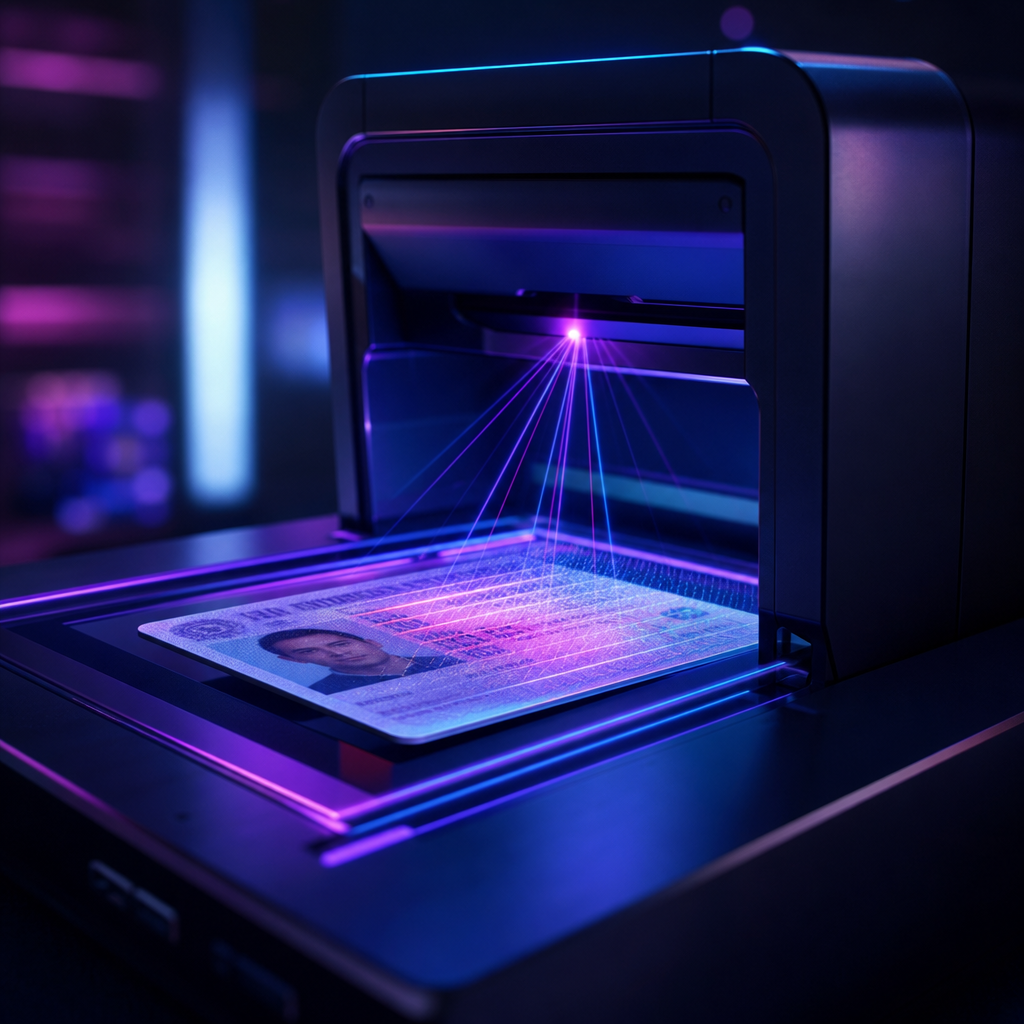
Security features are the next layer. Real holograms shift and change as you tilt the card, microprint stays crisp and readable under a little magnification, and UV features only show up under a blacklight. If a hologram looks like a flat sticker, if fine lines smear into mush under a loupe, or if the UV response is either blinding or completely absent, you're probably looking at a counterfeit.
The state on the card tells you what to look for
Every state builds its own security features into its licenses, which is exactly why a good fake is hard to fake everywhere at once. California hides a bear watermark that appears when you hold the card to the light, along with a raised signature and birth date and a repeating state seal under UV. Texas uses a laser-perforated state outline, color-shifting ink on the seal, and a tactile date of birth and signature you can feel with a fingernail. New York works a detailed NYC skyline into the background, adds a color-shifting boat image, and laser-engraves a signature you can feel. Florida runs an orange state outline under UV, fine-line patterns through the background, and encodes data on a magnetic stripe. You don't need to memorize all fifty states, but knowing the two or three you see most often at your door turns a vague hunch into a specific check.
When to reach for a light
A few simple tools sharpen everything above. Held up to a light, a real card shows its watermarks and stays opaque where it should be; if you can see through an area that ought to be solid, something's wrong. A magnifying glass or jeweler's loupe reveals whether the microprint and fine-line patterns are genuinely printed or just faked at low resolution, and whether the photo is truly integrated into the card. Under a blacklight, the state-specific UV features either appear the way they're supposed to or they don't. None of these take more than a moment, and together they catch the fakes that look fine at arm's length.
The person is part of the ID
Sometimes the card is decent and the person hands you the rest of the story. Watch for the nerves that don't fit the situation: heavy fidgeting, sweating, rehearsed-sounding answers, or a real reluctance to let go of the card. Ask a casual question or two and listen for the gaps. Someone using their own ID knows their address, their zip code, and roughly where they live; someone borrowing a friend's often stumbles on the details or can't place the town they supposedly call home. Group dynamics matter as well. Friends quietly coaching the answers, a cluster of IDs all from the same state but scattered across unlikely addresses, or a group that simply looks younger than the birth dates claim are all worth a second, closer look.
What to do when a card doesn't add up
When you're confident an ID is fake, the goal is to handle it cleanly, not to win a confrontation. Stay calm and keep your tone even. Follow your establishment's procedures rather than improvising, and note the incident in your log while the details are fresh. Politely decline the sale, and if local law requires you to hold the ID or contact authorities, do that. Handled calmly and consistently, a refusal is boring, which is exactly what you want it to be.
Where fakes come from, and why it helps to know
Understanding the supply side makes patterns easier to spot. A lot of counterfeits come from online vendors working off the same templates, so once you've seen one, you'll recognize its siblings. Local producers tend to repeat the same flaws card after card. Then there are the fakes that aren't fakes at all: a real ID borrowed from an older sibling or friend, or a genuine card that's been physically altered. Those last two are why the behavioral tells and the feel of the card matter as much as the security features.
Back your judgment with the right tools
Human checking is essential, but it gets tired and it gets busy, and fraudsters count on both. That's where scanning technology earns its place. A good scanner reads the barcode and magnetic stripe, validates them against the format the state actually uses, and quietly builds an audit trail every time. ID Verify does exactly that, layering barcode scanning and validation, pattern recognition, and database cross-referencing, and updating as new fake ID trends surface so your staff isn't relying on last year's knowledge. It won't replace a sharp employee, but it will catch the things a sharp employee misses at the end of a long shift.
Tools only help if your people know how to use them, so keep training real and regular. Short monthly refreshers on new fake trends go a long way, and there's no substitute for hands-on practice with actual confiscated fakes. Test your staff now and then with training IDs, pass along new alerts the moment you get them, and make it clear that if something feels wrong, they're empowered to slow down and check. Confidence built on practice is what turns all of this from a checklist into an instinct.
Know your footing, legally
You're on solid ground here. You can refuse service when you suspect a fake, you can confiscate one where local law allows, and a genuine good-faith effort to verify age protects you. The responsibilities are the mirror image: check everyone the same way instead of profiling by appearance, document your verification efforts, and report confiscated IDs as your jurisdiction requires. Consistency isn't just fair, it's your best defense if a decision is ever questioned.
The math that makes this worth it
Getting fooled is expensive in a way that dwarfs the cost of checking carefully. Depending on the jurisdiction and the circumstances, fines run from a few hundred dollars into six figures, and the money is often the smallest part. A serving license can be suspended or pulled outright, criminal charges can follow, insurance premiums climb, and the reputation you spent years building takes a hit that no fine schedule captures. Against all of that, a few extra seconds at the door is the cheapest insurance you'll ever buy.
So when a card doesn't sit right, don't make the sale. That instinct, backed by a quick set of checks and a scanner that never gets tired, is what keeps your license, your business, and your name out of trouble. ID Verify is built to take the guesswork out of that moment, catching the fakes that slip past even careful eyes so your team can trust what the screen tells them and get back to the job.