Advanced Fraud Prevention Strategies for 2024
Fraud is not a static problem. The person trying to get past your door or your register this year is working with better tools than they had two years ago, and they will have better ones still by the time you finish reading this. The good news is that the defenses have improved too. This is a practical look at what modern ID fraud actually looks like, and what you can do about it without turning every transaction into an interrogation.
What you are actually up against
The old mental picture of a fake ID is a teenager with a laminated card and a wobbly signature. That still exists, but it is no longer the interesting threat. The documents coming across counters now are produced with AI-assisted design, convincing photo work, and increasingly faithful copies of holograms, UV features, and the microprint that used to separate real from fake. Some of these are good enough that a careful person holding one under good light will still wave it through.
Alongside the physical fakes, there is a whole category of fraud that never involves a counter at all. Synthetic identities stitched together from real and invented data, account takeovers, manipulated documents, and organized retail crime rings all trade on the same weakness: a business that verifies identity casually, or not at all. Whether the attack arrives in person or through a screen, the fix starts in the same place, with treating verification as a real control rather than a formality.
The money involved explains why this keeps escalating. Retail loses somewhere north of $100 billion a year to fraud, healthcare around $68 billion, financial services roughly $25 billion, hospitality about $15 billion, and even the younger cannabis industry is already measuring losses in the billions. And those are only the direct numbers. The costs that do not show up on the theft ledger, the regulatory fines, the legal bills, the customers who quietly stop coming back after a bad experience, often outweigh the goods that walked out the door.
Defense works in layers, not silver bullets
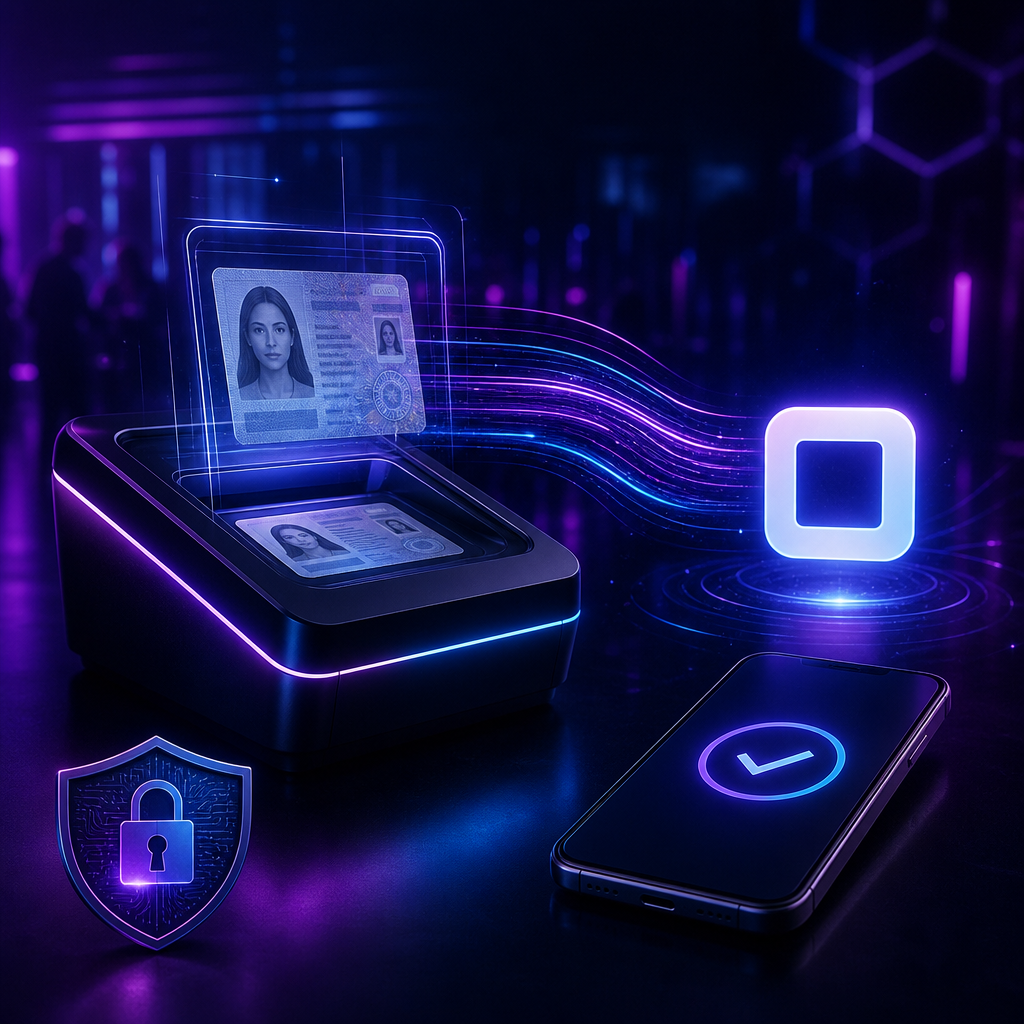
No single check stops a determined fraudster, so the goal is to stack independent checks that a fake has to beat all at once. The first layer is the document itself. A real ID carries physical security features worth inspecting, UV ink, holograms, microprint, tactile printing, and watermarks, but the more reliable move is to read the document electronically. Scanning the barcode or magnetic stripe, validating the format, and running the data through OCR catches inconsistencies that the eye misses, because a forger can copy a hologram far more easily than they can make the encoded data agree with the printed data.
The second layer is confirming the person matches the document. Comparing a live photo against the ID, checking for depth and liveness so a printed photo or a phone screen cannot fool the camera, and estimating age from the face all help close the gap between a valid ID and the person actually holding it. Higher-security environments layer in additional biometrics, but for most operators, a solid face-to-document match already eliminates the most common trick, which is a genuine ID belonging to someone else.
The third layer looks at behavior over time rather than any single transaction. Patterns give fraud away in ways a single document cannot: the same identity appearing in two impossible places, an unusual burst of activity, repeated failed attempts, or a profile that lines up a little too neatly with known fraud. This is where machine-driven fraud scoring and anomaly detection earn their keep, flagging the transactions that deserve a second look so your staff can spend attention where it matters.
Reading the room and the document
Technology does the heavy lifting, but trained eyes still catch things. On the document, watch for text that sits slightly off its baseline, fonts that do not quite match between fields, colors that are a shade wrong, edges that feel reworked, or lamination that bubbles or peels at a corner. Any one of these can be innocent wear. Two or three together on the same card is a pattern.
People give off signals too, though this is where judgment matters most. Genuine nervousness is common and rarely means fraud, so no honest customer should get treated like a suspect for being shy. What is worth noticing is the combination: rehearsed answers to simple questions, an eagerness to rush the transaction, or a group where one person is clearly steering. On the digital side, your systems should be surfacing their own tells, repeated attempts, data that does not reconcile, blacklist hits, and velocity triggers, so the human and the software are each covering what the other misses.
Where ID Verify fits
This is the problem ID Verify was built to handle. It performs real-time verification with multiple validation points, scores the risk on each check, raises alerts when something looks wrong, and keeps an audit trail you can actually produce later. Because it connects to the systems you already run, your POS, your compliance platform, your security databases, verification becomes part of the normal flow rather than a separate chore someone has to remember. The point is not to add a step. It is to make the step you already take actually mean something.
Training is the layer that decays fastest
The best system in the world underperforms in the hands of staff who do not understand it. Foundation training should cover how to inspect an ID, how to use the technology, what the policy actually requires, how to keep the customer interaction pleasant, and when to escalate. It sticks far better when people practice on real examples and mock scenarios instead of sitting through a slide deck, so build in hands-on reps and a simple certification before someone works unsupervised.
Then keep it current. Fraud tactics shift, so a short refresher on new trends, recent cases, and any policy changes goes a long way. Watch the numbers that tell you whether training is working, your detection rate, your false positives, how long checks take, and what customers say about the experience. A team that catches more real fraud while annoying fewer real customers is the goal, and those two metrics are how you know you are getting there.
The same principles, tuned to your business
The mechanics change by industry even though the logic holds. In retail, the pressure points are gift cards, electronics, designer goods, pharmacy items, and return fraud, and the countermeasures are purchase limits, ID checks on high-risk items, serial tracking, and clear return policies backed by staff who know them. Hospitality gets tested at check-in and payment, through reservation fraud and chargeback schemes, which is why advanced verification, deposit requirements, and guest screening pay off. Cannabis carries the heaviest compliance load, where age verification, purchase limits, guarding against interstate diversion, and validating medical status are not just fraud controls but the terms of keeping your license, so track-and-trace and audit-ready reporting are non-negotiable.
When something gets through
Even good programs get tested, so have a plan for the moment a check fails. If you catch fraud in progress, the priorities are straightforward: secure and document the evidence, notify management, contact the authorities when appropriate, and preserve your records. Handle the person calmly and by protocol, without accusations, and never at the expense of your staff's safety. A card that is refused politely is a story that ends. A confrontation is one that does not.
The follow-up matters as much as the moment. Gather the evidence, review footage, talk to the staff involved, and write down what you found while it is fresh. Depending on what happened, that documentation feeds law enforcement, regulators, industry databases, an insurance claim, or your own legal counsel, and it is a great deal easier to produce when your system has been quietly keeping an audit trail all along.
The compliance floor
Fraud prevention and legal compliance are the same work seen from two angles. Federal obligations around knowing your customer, anti-money-laundering rules, and privacy law set a baseline, and states layer their own requirements on top, covering how long you may retain an ID, which verification methods count, and what your customers can expect regarding their privacy. Meeting these rules is not only about avoiding fines. Documented policies, training records, and clean audit trails are exactly what protect you when you have to show that you did your due diligence, so the same records that keep you compliant also limit your liability.
Keeping it going
Fraud prevention is not a project you finish. The threats keep evolving, deepfakes get sharper, social engineering gets more convincing, synthetic identities get harder to unwind, so your defenses have to keep moving too. That does not require chasing every new buzzword. It means reviewing your numbers on a regular cadence, tightening the processes that are slowing people down, refreshing training when tactics shift, and adopting new tools when they genuinely earn their place rather than because they are new.
The math behind all of this is simple. Prevention almost always costs less than the fraud it stops, and the return shows up not just as reduced losses but as compliance you can prove and customers who trust you. Treat verification as a core part of how you operate rather than an afterthought, give your people good tools and good training, and stay a little paranoid in the right ways. With ID Verify handling the detection and the record-keeping, you get to focus on running the business while the checks that protect it run quietly in the background.